
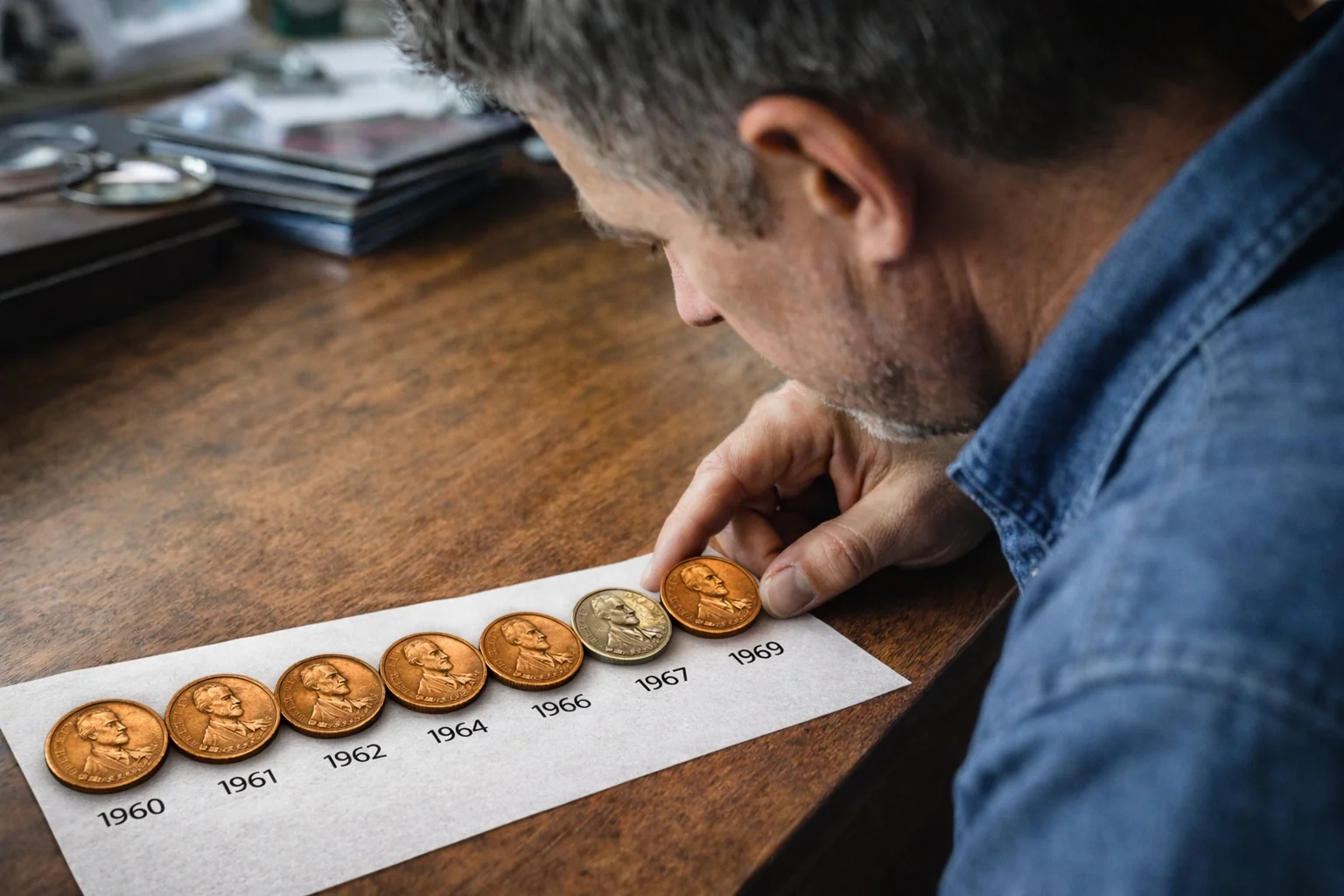
Collectors often compare Lincoln cents from the same decade to understand small differences in value. Questions about 1966 penny value usually appear when people start comparing this coin against other 1960s issues.
Some years attract attention because of market stories. And to understand the 1966 penny’s place, let’s look at the decade as a whole to compare condition, supply, and errors rather than relying on the date alone.
Basic Specifications of the 1966 Lincoln Penny
Feature | Details |
Year | 1966 |
Denomination | One cent |
Composition | Copper alloy (95% copper, 5% tin & zinc) |
Weight | 3.11 grams |
Diameter | 19.05 mm |
Edge | Plain |
Obverse | Abraham Lincoln |
Reverse | Lincoln Memorial |
Mint mark | None (Philadelphia) |
Intended use | General circulation |
These specifications set a clear starting line. Any major deviation usually points to wear, damage, or mint error. And to better compare across the 1960s, learning weight, size, and design is essential (for judging condition or value).
Composition Matters: Silver Years vs Copper Years
All Lincoln cents from the 1960s use a copper-based composition. Unlike some other U.S. coins of the era, pennies did not contain silver. This removes one common source of value comparison.
Before 1982, Lincoln cents were struck in a copper alloy. The 1966 penny follows this standard. Its metal content does not provide a price floor above face value.
Thus, the value differences within the decade depend on factors other than composition. Metal does not separate 1966 from 1962, 1964, or 1967. The market treats them equally in that respect.
Collectors sometimes expect metal changes around the mid-1960s. That expectation does not apply to pennies.
Mintage Numbers and Market Supply Across the Decade
Production of Lincoln cents remained high throughout the 1960s. Millions of coins were struck each year to support daily circulation. The goal was a stable supply rather than collectibility.
1966 fits directly into this pattern. The issue was large, and the distribution was wide. Thus, coins were used commonly and heavily.
Approximate Lincoln Cent Mintages by Year (1960s)
Year | Approximate total mintage |
1960 | ~2.0 billion |
1961 | ~2.8 billion |
1962 | ~3.1 billion |
1963 | ~3.8 billion |
1964 | ~5.0+ billion |
1965 | ~3.7 billion |
1966 | ~2.1 billion |
1967 | ~3.0 billion |
1968 | ~3.0 billion |
1969 | ~4.0 billion |
High production explains why many examples survive today. It also explains why most surviving coins show wear. Large mintages do not guarantee easy access to well-preserved pieces.
Market supply today reflects circulation history more than original mint totals. Years with similar production numbers can show different availability in higher grades due to how heavily the coins were used.
Condition as the Real Divider Between 1960s Pennies
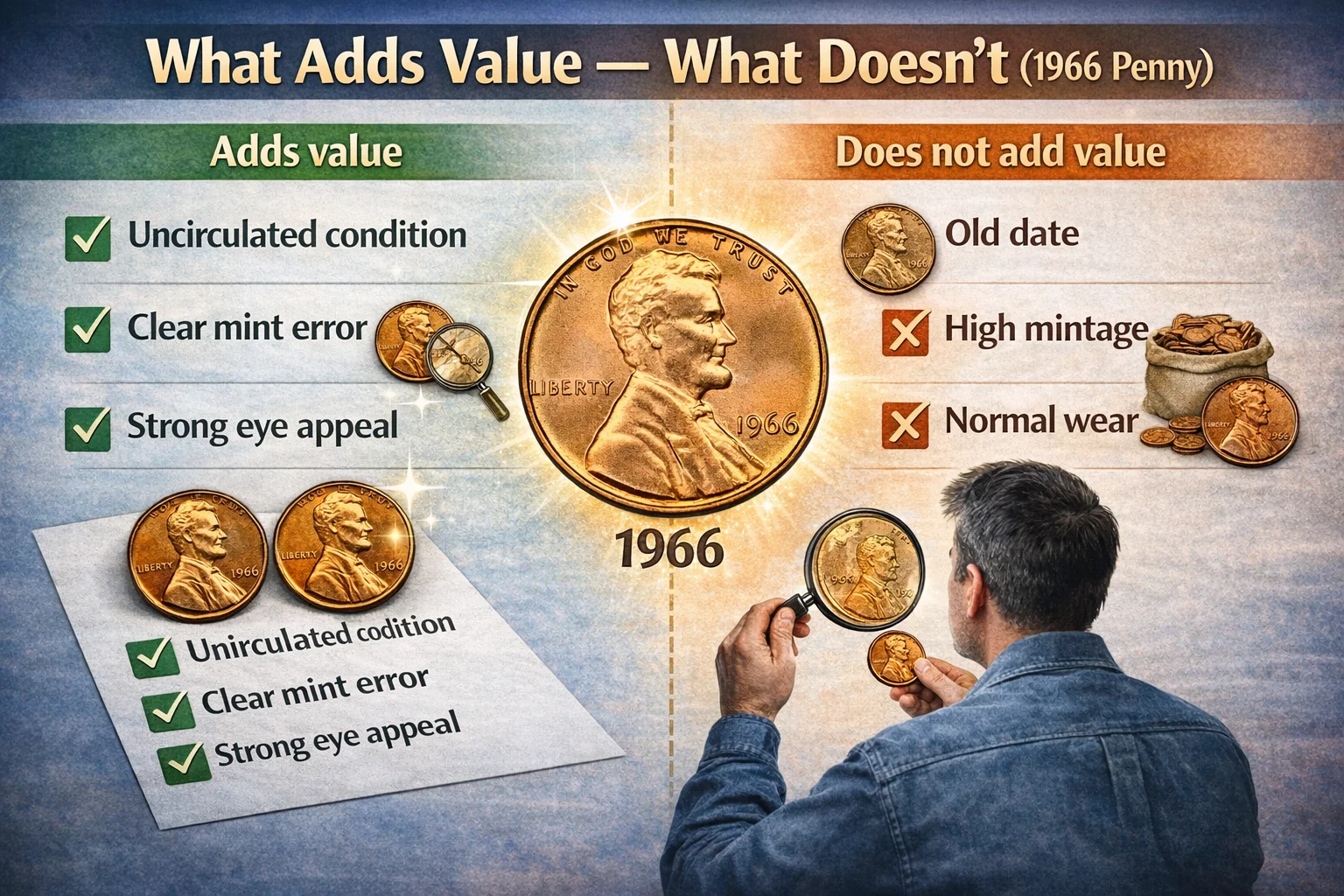
Condition is the main factor separating pennies of the same decade. This applies fully to the 1966 penny.
Wear follows a predictable pattern. High points lose detail first. Flat areas expand over time. Once detail is lost, it cannot return.
Common wear areas on Lincoln cents include:
Lincoln’s cheek and jaw
Hair above the ear
Coat and shoulder lines
Memorial columns and steps
Two pennies from the same year can look very different today. One may be dull and flat. Another may retain sharp detail and original surface texture.
This difference drives market value more than date or mintage.
Comparing the 1966 Penny to Other Key Years of the 1960s
Early 1960s (1960–1962)
These cents have the same, similar characteristics to 1966. Design and composition match. Market behavior is also similar.
Differences appear mainly in the condition. Early-1960s coins often circulated just as heavily as 1966 examples.
Mid-Decade (1963–1965)
These years often attract attention because of their position near larger changes in U.S. coinage. Expectations tend to be higher than actual prices.
1966 does not differ much from these years in market terms. Supply remains high. Demand remains steady.
Late 1960s (1967–1969)
Later years sometimes survive in better condition. Even then, price differences stay small.
When compared directly, 1966 often sits in the middle of the decade.
Where the 1966 Penny Fits in the 1960s Market
The 1966 penny does not stand out sharply in either direction. It is not overlooked, and it is not overvalued.
Its position is stable. It sits between earlier and later issues without a strong market bias. This is why it often appears in discussions about coins worth money, even though it rarely leads those lists.
Collectors use 1966 as a benchmark year. It reflects average survival, average demand, and average pricing within the decade.
The market views it as representative rather than exceptional.
Errors Across the 1960s: Does 1966 Stand Out?
Mint errors exist across the entire decade. The 1966 penny doThe letter shows a higher error rate than neighboring years.
What matters is the type and clarity of the error, not the date. Strong, visible errors attract interest regardless of the year.
Many perceived errors are the result of die wear or circulation damage. These do not carry lasting premiums.
Key 1966 Penny Mint Errors
Error type | Description | Typical value range |
“L” in LIBERTY on rim | The letter touches or reaches the rim due to die wear | $2–$10 |
Doubled Die Obverse (DDO) | Doubling on date, letters, or Lincoln’s profile | $30–$150+ |
Grease strike | Weak or missing design elements | $10–$60 |
Off-center strike (10–20%) | Image shifted outside collar | $15–$100+ |
Lamination | Peeling or flaking metal | $10–$50 |
Die break / cud | Raised metal near the rim or devices | $25–$150 |
Important Notes for Collectors
No mint mark is normal for 1966 pennies.
Many “L on rim” examples come from heavy die wear.
Clear, well-defined errors matter most.
Worn or unclear defects bring limited interest.
For checking characteristics, minting details, estimated costs, and even record keeping, some collectors use Coin ID Scanner. This best coin value app helps confirm coin type, store collection digitally, and askan AI helper in case of questions. But professional inspection still determines the final judgment.
Final Points
The 1966 penny reflects the center of the 1960s Lincoln cent market. Supply is strong, demand is steady, and prices remain stable.
Value depends on condition and errors, not the date alone. Most standard examples trade close to face value. Strong errors and high-grade pieces form a small exception.
Understanding all these nuances helps set realistic expectations. The 1966 penny does not rely on hype. It shows how the market treats widely available coins over time.